Platform Technology

Our nanoporous DBR solves
a 30-year industry challenge

One patented electrochemical process unlocks manufacturable light sources across wavelengths the industry has failed to reach for three decades.

🔑
The core insight
GaAs VCSELs dominate 850-940 nm because the AlGaAs/GaAs n-DBR stack delivers ~16% refractive-index contrast for high mirror reflectivity. InP and GaN lattice-matched alloys only offer ~0.3% contrast. InPHRED's nanoporous etching engineers >40% contrast from scratch on the same foundry epi the industry already uses.

30-year deadlock — and how we solved it

The industry has been stuck for 30 years
1
GaAs VCSELs dominate NIR (850–980 nm) because AlGaAs/GaAs forms a near-perfect homoepitaxial DBR mirror pair: high refractive-index contrast, mature process, wafer-level testable, low cost. These VCSELs are in every iPhone and LiDAR sensor today.
2
InP (SWIR) and GaN (visible) have no equivalent DBR pair. Lattice-matched InP alloys yield only ~0.3% index contrast versus ~16% for AlGaAs/GaAs, far below the ~99.9% mirror reflectivity required to sustain a VCSEL optical cavity. GaN faces the same fundamental barrier.
3
All workarounds fail to scale. Heteroepitaxial growth is expensive and defect-prone. Wafer fusion disrupts the monolithic process flow. Double dielectric DBRs require complex post-processing. No competitor has achieved low-cost, wafer-level InP or GaN VCSELs commercially.
InPHRED's patented nanoporous solution
Electrochemical nanoporous etching selectively converts n⁺-doped semiconductor layers into nanoporous material — reducing local refractive index by a precisely controllable amount, determined entirely by porosity. Undoped layers remain unchanged.
Homoepitaxial DBR with engineered index contrast. Alternating dense and nanoporous layers create refractive-index steps of up to ~40% (exceeding AlGaAs/GaAs contrast) on standard foundry-grown InP or GaN epi. No exotic materials or wafer fusion are required.
Drop-in compatible with volume manufacturing. The porosification step is a single post-epi electrochemical process added to a conventional wafer-level flow. We leverage foundry fab and on-wafer testing compatible with the compound semiconductor supply chain.
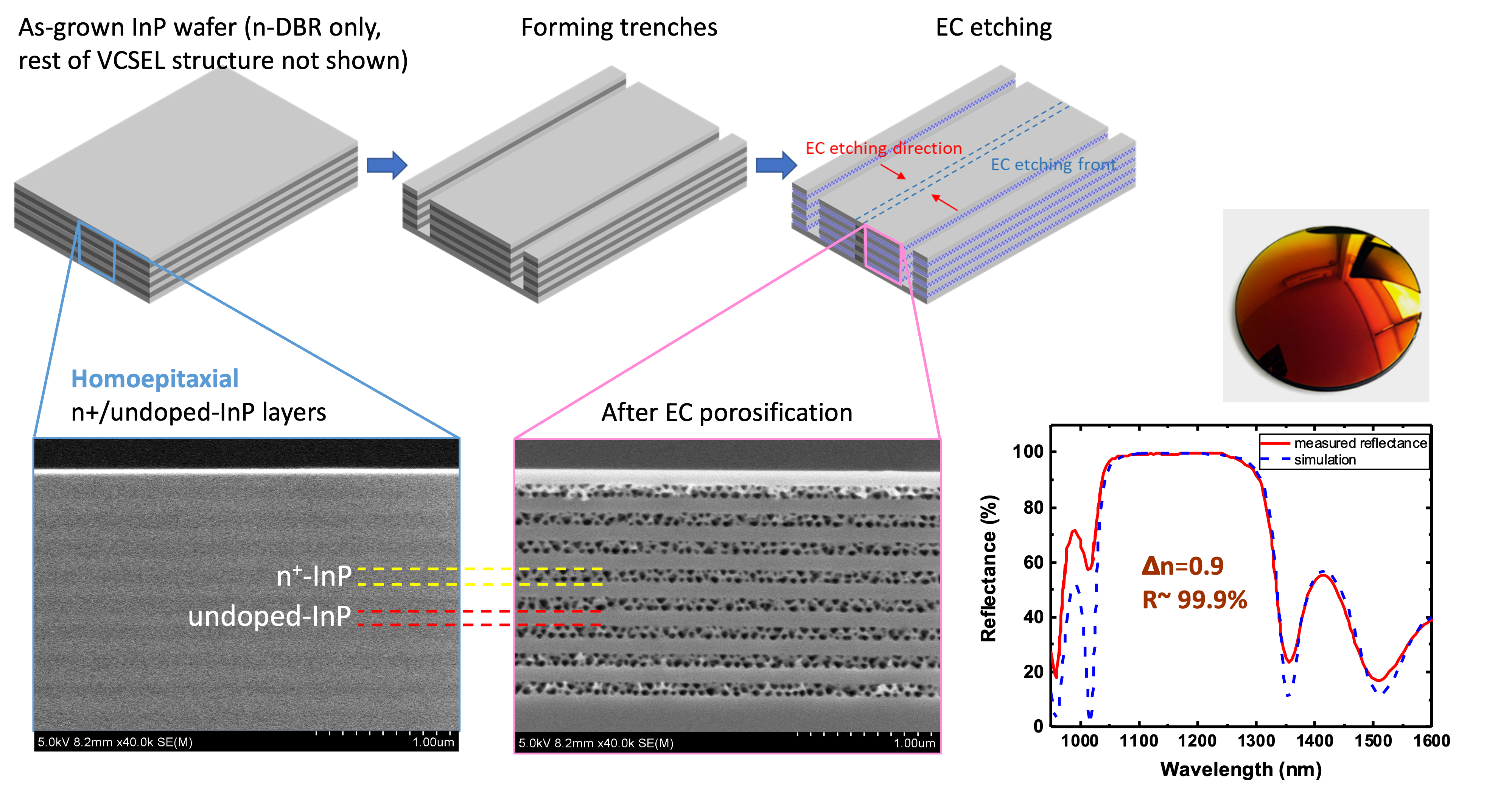
Nanoporous InP DBR formation

Nanoporous DBR formation: homoepitaxial InP layers undergo electrochemical etching to form nanoporous DBR with Δn=0.9 and R~99.9%
Figure 1. Selective porosification produces a high-contrast Bragg reflector (Δn ≈ 0.9, R ~ 99.9%)

World's first mass-market SWIR VCSEL

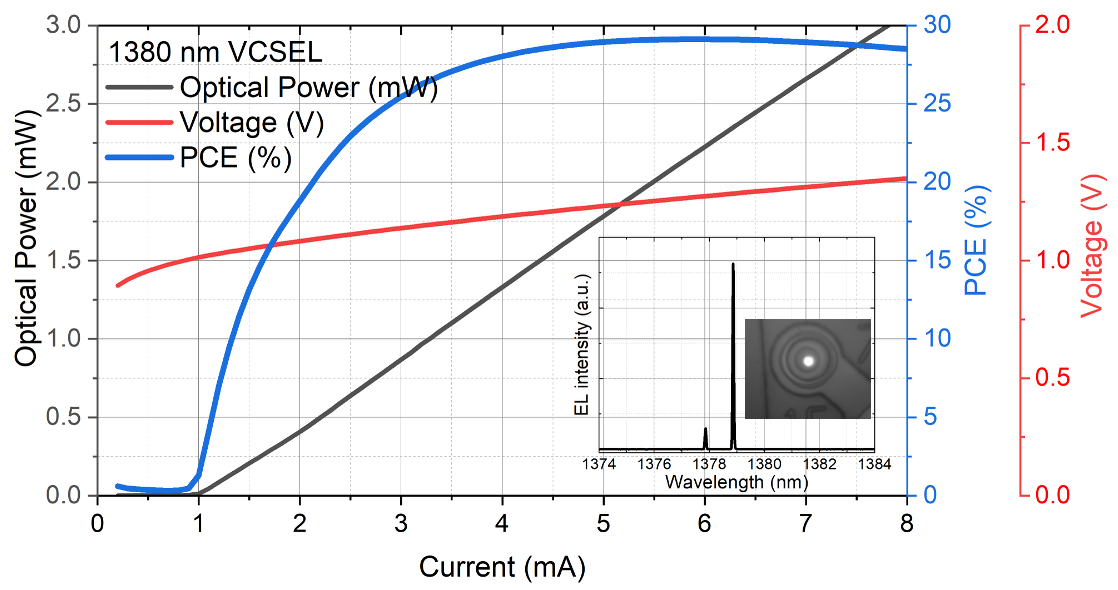
1380 nm InP VCSEL performance: optical power, voltage, and PCE vs current with EL spectrum inset
Figure 2. LIV characteristics of the 1380 nm SWIR VCSEL showing ~30% peak PCE and single-mode lasing at 1378 nm

One platform technology. Two product families. Three markets.

Platform technology

One nanoporous platform

The same patented electrochemical process can be applied across material systems (InP, GaN) to unlock new device types (VCSEL, RC-LED, EEL), light modes, and integration approaches.

InP validated GaN validated Foundry-compatible
InP · 1,300 – 2,300 nm

SWIR VCSEL

The world's first manufacturable short-wave infrared VCSEL using a homoepitaxial nanoporous InP DBR. Eye-safe, high-SNR, and manufactured at foundry scale.

Consumer sensing Automotive LiDAR Non-invasive glucose Data center I/O
GaN · 450 – 570 nm

Visible RC-LED

Our resonant-cavity (RC) LED emitting in the blue-green spectrum has high spectral purity and directionality for precision health sensing and die-to-die optical links.

Health wearables Biomarker sensing Chip-to-chip USR links

A deepening IP moat

InPHRED's patent portfolio covers the core nanoporous DBR process, its application to specific material systems and device geometries, and downstream integration approaches. The portfolio grows with every new application we develop.

Discuss licensing or partnerships
  • Core porosification process — electrochemical conversion of n⁺-doped InP and GaN layers to nanoporous semiconductor with controlled porosity and index contrast
  • InP VCSEL DBR architecture — nanoporous/dense InP layer pairs forming a homoepitaxial Bragg reflector for SWIR lasing (1,300–2,300 nm)
  • GaN RC-LED for wearables — nanoporous GaN DBR mirrors bounding a visible-light resonant cavity for high-spectral-purity emission (450–570 nm)
  • Additional patentable technologies — 2–4 further patentable innovations developed since our seed round, covering advanced device and process variations

Want to go deeper?

Our technical briefs cover DBR physics, device characterisation data, and application-specific analyses. Request access or reach out to discuss a custom engagement.