The case for SWIR VCSELs in next-generation consumer sensing
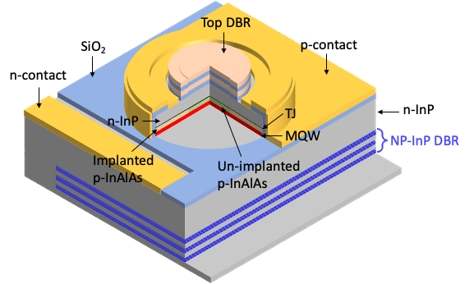
A comprehensive analysis of why short-wave infrared (SWIR) VCSELs outperform near-infrared (NIR) alternatives for 3D sensing, AR/VR, and LiDAR; covers SNR headroom, eye safety, range extension, and the role of InPHRED's nanoporous DBR in making SWIR VCSELs manufacturable at commercial scale.
Whitepapers, briefs & application notes
Browse our complete library of technical content. Filter by type, or contact us to request access.
Visible GaN RC-LED for wearable health sensing
How InPHRED's blue/green RC-LED improves health metric accuracy versus conventional broadband LEDs with improved spectral selectivity, better skin-tone independence, and access to new biomarkers.
Nanoporous InP DBR: physics, fabrication, and performance
An introduction to the electrochemical porosification process — how selective anodisation of n⁺-InP creates a homoepitaxial Bragg reflector with tunable refractive-index contrast exceeding AlGaAs/GaAs.
Non-invasive optical glucose monitoring with SWIR photonics
How SWIR wavelengths penetrate skin and adipose tissue to isolate blood glucose signal — combining multiple SWIR and NIR wavelengths to address the accuracy limitations of prior NIR-only attempts.
RC-LEDs for ultra-short-reach optical interconnects
Resonant-cavity LEDs as a low-power, high-bandwidth alternative to VCSELs and copper for die-to-die and chiplet integration — benchmarking bandwidth density and power consumption at <1 pJ/bit.
SWIR LiDAR for all-environment automotive ADAS
Why SWIR wavelengths outperform visible and NIR LiDAR for long-range highway ADAS: eye safety at high power, reduced solar background interference, and superior performance in rain, fog, and dust.
Stay current with InPHRED research
We publish new technical resources as our technology matures across SWIR and visible applications. Register your interest to be notified.
No spam. Relevant technical content only. Unsubscribe at any time.